Project
£19/mo · included from ProPayment applications, notices and retention
Miss the cut-off for an application and you wait a month for money you’ve already spent. Numbered interim and final applications against the job, with the net worked out from cumulative gross value less retention less whatever was certified before. The payment notice and the pay-less notice are recorded with the amount, the date served and the basis given. Create a retention release and it raises the invoice. Included from Pro up.
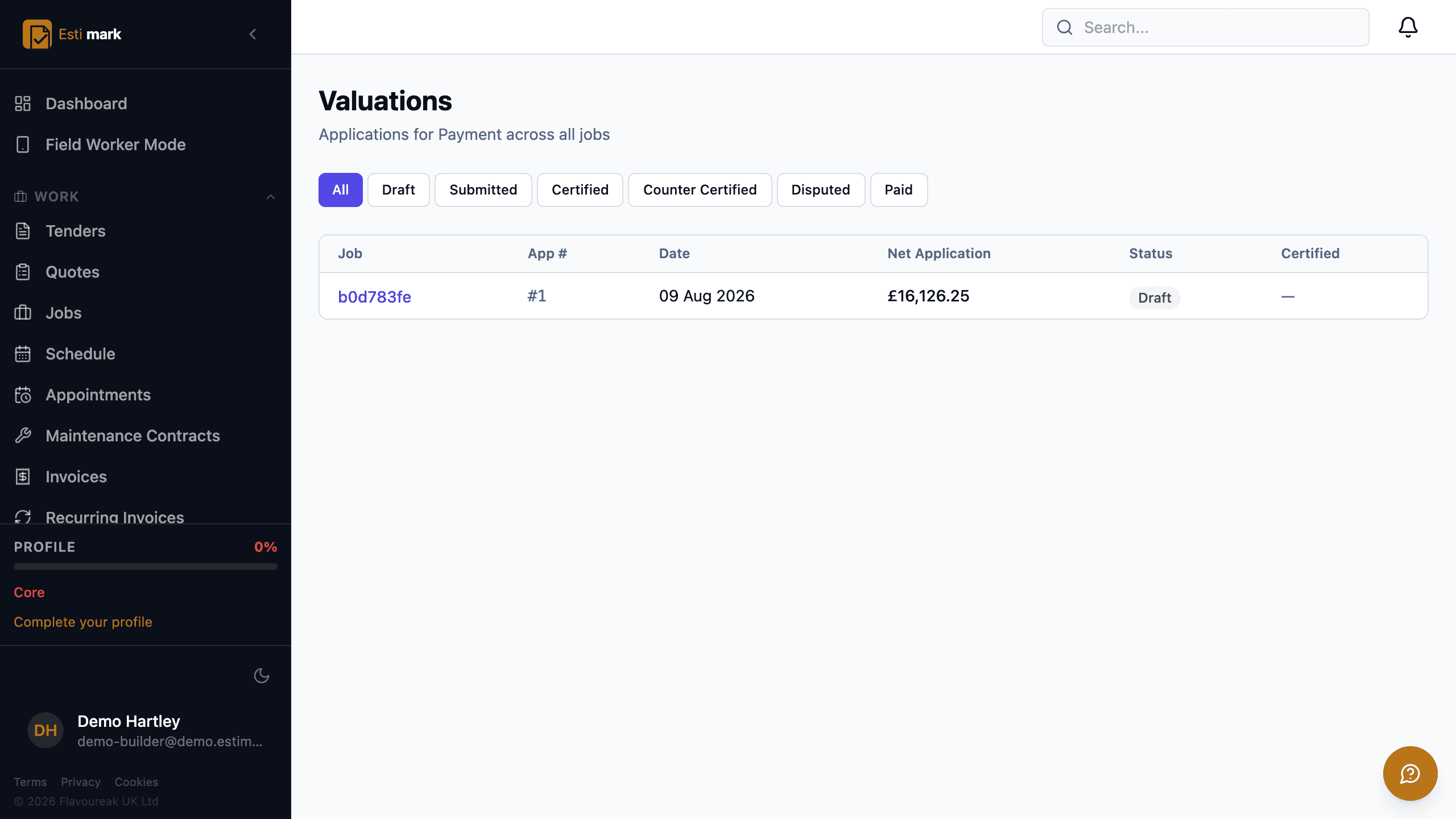
What the Payment Applications module does
- Numbers each application, with a reference, an application date and a period from and to.
- Holds gross cumulative value, retention percentage, retention amount, previous certified and the resulting net application.
- Runs through draft, submitted, certified, counter-certified, disputed and paid.
- Keeps the certified amount, date and certifier separate from what you applied for, because those two figures are rarely the same.
- Holds a due date and the final date for payment as separate fields.
- Records a payment notice: amount, date served and the basis on which it was calculated.
- Records a pay-less notice: amount, reason, date served and basis.
- Marks an application as final.
- Creates a retention release with a release date, a type, an amount and the total retention held. Making it raises the invoice. It also tracks whether the reminder for that release has gone out.
Payment Applications: how it works
How is a payment application calculated?
Cumulative gross value of work done, less retention at the agreed rate, less everything certified before now. What’s left is what you’re applying for this period. Every one of those figures is stored on the application, not just the total, so when the QS queries it you can walk him through it line by line.
| Line | Field |
|---|---|
| Cumulative value of work done | gross cumulative |
| Less retention | retention % and amount |
| Less previously certified | previous certified |
| = Net applied this period | net application |
What are payment notices and pay-less notices?
Under the Housing Grants, Construction and Regeneration Act 1996 as amended, a payer has to serve a payment notice saying what sum it considers due and how it got there. If it means to pay less than the notified sum, it has to serve a pay-less notice before the final date for payment. Miss the notice and the sum you applied for can become the notified sum. That is a good day for you and a bad one for them. Estimark keeps both notices with the amount, the date served and the basis stated.
NoteEstimark records the notices and their dates. It doesn’t serve them for you, and it won’t work out your contractual notice deadlines. Those come off your contract, and they vary.
How is retention released?
As its own record: release date, release type, amount, and the total retention held. Creating it raises an invoice. It also tracks whether the reminder for that release went out, because retention nobody chases tends to stay exactly where it is.
Payment Applications: at a glance
- Plan
- Included from Pro
- Add-on price
- £19/month
- Statuses
- 6, incl. disputed
- Notices
- Payment + pay-less
Payment Applications
£19per month
Payment Applications is a bundled module. Plans are a ladder, so it comes with Pro and with Enterprise. On a lower plan you can switch it on by itself for £19 a month.
Included from Pro, £299 a month
- Included on Pro and above at no extra cost.
- £19 per month as an individual module on a lower plan.
- Included in full during the 14-day free trial.
- No implementation fee and no minimum term.
Questions
Payment Applications: frequently asked
Which plan includes payment applications?
It’s included from Pro up. On a lower plan it’s £19 a month on its own. Retention release comes with it.
Does Estimark handle retention?
Yes. Every application carries a retention percentage and amount. A release is a separate record with its own date, type, amount and the total held, and creating it raises the invoice. It tracks the reminder too, so a release doesn’t sit there for two years.
Does Estimark serve pay-less notices for me?
No. It records the notice: the amount, the date served, the basis given. Serving it inside the contractual timescale is down to you, and the timescale is the part that catches people out.
Can a payment application become an invoice?
An application links to an invoice and holds Xero and QuickBooks references, so you can trace a pushed invoice back to the application it came off.
Related
Job Costing
The cost side of the same job, against a frozen baseline.
Variations
Approved variations forming part of the value applied for.
Cash Flow Forecasting
Certified against actual curves and payment-timing alerts.
For builders & contractors
Pro at £299/month. Payment applications, HR, training, plant and fleet.
Payment applications & retention
Interim applications, retention, payment and pay-less notices under the Construction Act.
Job costing & CVR
Actual, committed and forecast cost per job, with a cost value reconciliation pack.
Pricing & plans
Solo £39, Core £129 and Pro £299 a month plus seats. Enterprise is quoted. Bolt-ons are priced separately.
Try it on a real job.
14 days, full access, every plan. No implementation fee.